


Udemy
Timeline
Jul - Aug 2024
Role
Design Strategist, UI Designer
Type
Class Project
Collaborators
Natalia Naranjo, Weiwei Chen
Introduction
Millions enroll on Udemy. Few finish. Courses are flexible, but learners go through them alone, and without anyone to check in, motivation fades.

Let me ask you this:
How many times have you enrolled in and paid for a course, and never completed it?
Problem
Navigating the Journey of Learning Alone
Learners need help and encouragement along the way. But on Udemy, when students hit roadblocks, they often face delays and silence, less than 10% even ask questions, and many drop out early due to lack of support.
The strategy
A structured journey designed to bring human connection back to online learning.
Reimagining Udemy courses around community and real-time engagement unlocks higher motivation and deeper learning. What if students never had to navigate their courses alone again?
Introducing
Udemy Cohort
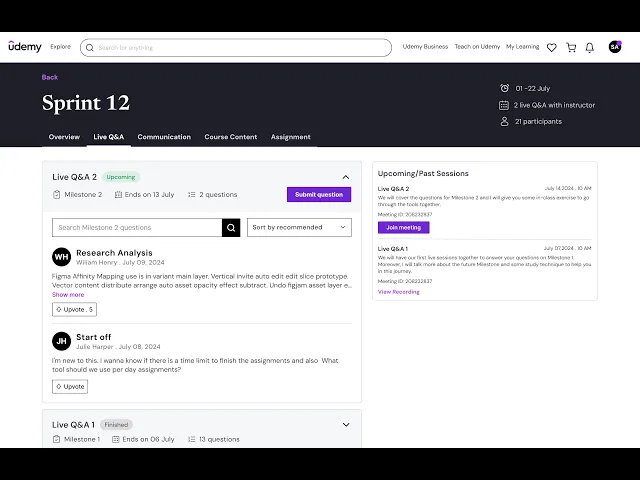
A cohort-based learning experience that brings structure, community, and live check-ins to Udemy courses. Designed to help students stay on track, connect with peers, and complete what they start.

Research
Investigating the Dropout Problem
We researched why learners drop off and whether cohorts help, using platform data, industry studies (2020 to 2024), and cohort program examples. We also asked instructors in online communities for direct feedback.

Desk research
Why do learners drop off in self-paced courses?

White paper research
How can cohort-based learning improve completion and engagement?

Instructor outreach
Are instructors open to the extra work cohort models require?
Key insights

Most Learners Drop Out Before They Begin
About 70% of Udemy students never start the courses they buy. The average learner watches about 30% of a course, and roughly 10% finish.
“Online classes without accountability suffer about a 97% drop-off rate.”
Might Could Studios

Why Learners Quit
Impulse enrollments: Discounts and free promos lead learners to stockpile courses they never plan to finish.
No Accountability or Motivation: Without deadlines, instructors, or peer pressure, users lose momentum fast.
Long, uneven content: Courses often run 10+ hours, vary in quality, and lack pacing.
“200 students with 0% completion rates. They just signed up using a free link and never showed up.”
An instructor on Reddit

Cohorts Help Learners Finish
Cohort courses see 5–10x higher completion than self-paced ones; Harvard Business School Online reports over 85%. Cohort learners also report higher engagement (90% vs 60%) and motivation (85% vs 70%). Programs like HBS cost more and select their learners, so Udemy’s lift would likely be smaller.
“Cohorts don’t just boost engagement — they build belonging.”

Instructors Are In, If the Value Is Clear
Some instructors already run cohorts on their own, using Zoom and Discord, and charge directly. They like the idea but don’t see what Udemy adds. To win them, Udemy has to offer something they can’t get elsewhere.
“I already run cohort-style sessions outside of Udemy and charge significantly for them. I'm not sure what Udemy's contribution would be.”
A instructor on Udemy Instructor Community
Learners quit when they’re alone, and cohorts give them a reason to stay. The open question is instructors.
How Might We…
Build accountability without killing flexibility?
Share value with instructors in a way that feels fair?
Design motivation into the learning journey itself?
Business Goals
Cohorts could cut churn and open new revenue for Udemy, but only if instructors benefit too, through better revenue share, time-saving tools, or more visibility.

Cohort programs can help reverse Udemy’s declining net dollar retention rate (NDRR), which dropped from 115% in 2022 to 98% in 2024, by improving long-term engagement.
Live cohort formats see 75–90% completion rates, translating to better skill outcomes and ROI—especially valuable for enterprise clients, where stronger results can drive renewals and upsells.
For subscribers, cohort-based courses can maintain momentum, reduce drop-off, and increase the likelihood of course completion—directly impacting renewal and satisfaction rates.
Higher retention means less reliance on constant paid advertising, helping Udemy improve marketing margins.
Instructor-led cohort courses open the door to multi-week, higher-priced offerings, increasing average revenue per user (ARPU).
Conclusion
Notes on moving forward
With a short timeline, research was mostly desk-based, plus community listening and a few instructor conversations. Next, I’d validate before building:
Primary Research
Interview instructors who already run cohorts outside Udemy, and test the flow with learners to see if it feels intuitive and motivating.
How I’d measure it
completion vs. self-paced baseline, week-2 retention, questions asked per learner, and instructor opt-in rate.
Scalability
Explore how cohorts fit Udemy Business, through hybrid formats, facilitator-led sessions, or limited-time runs.


